Source Toilet Siphon for Bathrooms, Hotels, and Offices
Compare 30 toilet siphon models with siphonic drainage, ceramic construction, and water-saving features. Buyers can evaluate one-piece and two-piece structures, rough-in dimensions, and customization options for residential and commercial applications.
Key considerations
Products List



Comprehensive Sourcing Guide
Strategic Sourcing Guide for Siphonic Toilet Procurement
Understanding Siphonic Flush Mechanics and Design Architecture
The core keyword "toilet siphon" refers to a specific flushing mechanism that utilizes a siphonic action to evacuate waste. Unlike washdown systems that rely primarily on water volume and gravity to push waste through the trapway, siphonic toilets create a vacuum effect. This mechanism is defined by a fully glazed trapway that extends from the bowl to the drain outlet, allowing water to flow at high velocity and pull waste out with minimal residual water left behind. In the context of modern procurement, the observed product attributes indicate a strong prevalence of the "Siphonic" drainage type among available inventory. This design choice is critical for buyers seeking quiet operation and superior hygiene, as the siphonic action ensures a cleaner bowl surface with less splashing compared to alternative flushing technologies.
The structural integrity of the siphonic system is often tied to the overall construction of the unit. The supplied data reveals a market split between "One Piece" and "Two Piece" structures. One-piece models, such as those identified by model numbers like tz-9129, integrate the tank and bowl into a single ceramic body. This design reduces potential leak points and offers a sleek, "Modern Concise" aesthetic that is highly desirable in contemporary residential and commercial bathrooms. Conversely, two-piece structures, exemplified by model 2024-293, offer a traditional assembly where the cistern is mounted separately. While the two-piece design may offer easier logistics for shipping due to smaller package dimensions, the one-piece siphonic unit generally provides superior structural rigidity and a more seamless water flow path, which is essential for maintaining the vacuum required for effective siphonic flushing.
Technical Specifications and Dimensional Compliance
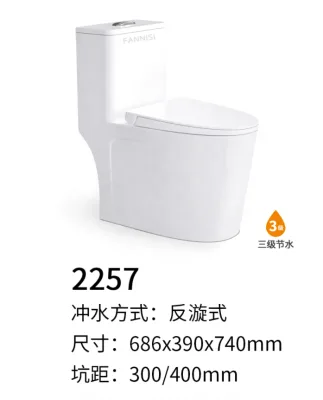
When evaluating siphonic toilets, precise technical specifications are non-negotiable. The physical dimensions of the unit must align with the architectural constraints of the installation site. The observed product standards highlight a range of dimensions, with specific examples including 690375750mm and 720420720mm. These figures represent the height, width, and depth of the units, which vary significantly based on the "Rough in" distance. The rough-in dimension, defined as the distance from the wall to the center of the drain pipe, is a critical compatibility factor. The data indicates available options for 300mm and 400mm rough-in distances, with some models supporting a range of 300-400mm. Buyers must verify the exact rough-in requirement of their facility before ordering, as a mismatch can render the installation impossible without costly structural modifications.
Water consumption is another paramount technical specification, particularly for regions with strict environmental regulations or for buyers targeting "Water Saving Type" certifications. The observed data points to water displacement ranging from 3.0L to 6.0L per flush, with specific mentions of 4L-6L consumption. This range suggests that while some units are optimized for high efficiency, others operate at standard volumes. For a siphonic system to function correctly, the water volume must be sufficient to fill the trapway and initiate the siphon without wasting resources. Buyers should request specific flush volume data for each model, as the efficiency of the siphonic action is directly dependent on the precise water volume delivered by the flush valve. Additionally, the "Built-in Cistern" attribute confirms that the water storage is integrated, which simplifies plumbing but requires careful measurement of the available space behind the toilet.
Compliance, Certification, and Material Standards
In the B2B procurement of sanitary ware, verifying material quality and adherence to standards is essential for long-term durability and safety. The primary material observed in the supplied product list is "Ceramic." High-quality ceramic is vitrified to ensure non-porosity, which prevents staining and bacterial growth. However, the mere mention of "Ceramic" does not guarantee compliance with international safety or performance standards. Buyers must explicitly request documentation regarding the kiln firing temperature and the glazing process, as these factors determine the hardness and chemical resistance of the bowl.
Regarding standards, the data lists specific product standard codes such as 690375750mm and 72X39X79mm, which appear to be dimensional specifications rather than regulatory certifications. It is crucial for buyers to distinguish between physical dimensions and actual compliance standards (such as ISO, ANSI, or local building codes). The absence of explicit certification names in the provided text means that procurement teams cannot assume a product is certified for specific markets without direct verification. Buyers should demand proof of compliance with relevant national plumbing codes and water efficiency standards. Furthermore, the "OEM/ODM: Accept" attribute indicates that suppliers are open to custom branding, but this does not imply that the base product meets the specific regulatory requirements of the buyer's target market. Verification of third-party test reports for water efficiency, flush performance, and structural load is a mandatory step before finalizing any purchase order.
Cost Drivers and Economic Factors in Sourcing
The price range observed in the market spans from 15 to 224 USD, a significant variance that reflects differences in material quality, design complexity, and brand positioning. Several factors drive these costs. First, the "One Piece" structure generally commands a higher price point than the "Two Piece" alternative due to the more complex manufacturing process required to fuse the tank and bowl into a single unit. Second, the inclusion of accessories such as "PP Seat Cover" and "Flush Valve" can influence the final unit price. Models that include high-quality, durable seats and reliable flush mechanisms will be positioned at the higher end of the price spectrum.
The "Minimum Pit Spacing" of 300-400mm and the "Rough in" requirements also impact logistics and installation costs. Units with larger dimensions or specific rough-in configurations may require specialized shipping or installation labor, indirectly affecting the total cost of ownership. Additionally, the "Customization: Available" attribute suggests that buyers can request specific colors, such as the observed "White," or tailored dimensions, but these custom orders often come with higher Minimum Order Quantities (MOQ) and longer lead times. The observed MOQ range of 1 to 1000 units indicates flexibility for small buyers but also suggests that bulk pricing tiers are likely available for larger orders. Buyers should analyze the total cost of ownership, including shipping, installation, and potential returns, rather than focusing solely on the unit price.
Supplier Evaluation and Operational Capabilities
Evaluating suppliers for siphonic toilets requires a deep dive into their operational capabilities and geographic location. The data indicates that the "prod_origin" is primarily "Guangdong, China" or generally "China." Guangdong is a major manufacturing hub for sanitary ware, known for its extensive supply chain and expertise in ceramic production. However, the concentration of suppliers in this region necessitates rigorous due diligence. Buyers should verify the supplier's production capacity, quality control processes, and ability to handle "OEM/ODM" requests.
The "Structure" of the supplier's organization is also relevant. Suppliers offering "One Piece" toilets must have advanced kiln technology and precise molding capabilities. Those offering "Two Piece" models may have more flexible production lines but need to ensure the sealing between the tank and bowl is robust. The "Style" attributes, ranging from "Modern Concise" to "European," suggest that suppliers cater to diverse aesthetic preferences. Buyers should request samples to verify the finish quality, glazing consistency, and the fit of components like the "Flush Button Type," which is observed as "Side Buttons" or "Top Push Button." Additionally, the "Product Name" variations, such as "Floor Ceramic Toilet" or "Bathroom Sanitary Ware Wc Toilet," indicate that some suppliers may have inconsistent product naming, which can lead to confusion in ordering. Clear communication of technical requirements and model numbers is essential to avoid miscommunication.
Quality Control and Long-Term Procurement Considerations
Ensuring the quality of siphonic toilets requires a proactive approach to quality control (QC). The "Siphonic" drainage mechanism relies on precise engineering; any deviation in the trapway diameter or glazing thickness can compromise the flushing performance. Buyers should implement a QC protocol that includes visual inspections for cracks, chips, or glazing defects, as well as functional testing of the flush mechanism. The "Water Consumption" and "Water Displacement" specifications must be verified through actual flushing tests to ensure the siphon activates correctly and the bowl is thoroughly cleaned.
Long-term procurement considerations also involve the availability of spare parts and after-sales support. The "Accessories" listed, such as the "PP Seat Cover" and "Flush Valve," are consumable items that may need replacement over time. Buyers should confirm that the supplier offers a steady supply of these components and that they are compatible with the specific model purchased. The "Installation Type" is noted as "Floor Mounted" or "Standing Floor," which requires stable flooring and proper sealing to prevent water damage. Buyers should also consider the "Working Voltage" of 220V for any electronic components, although the observed data indicates that features like "Electric Heating Washer" and "Hot Air Blowing" are typically absent in these standard ceramic models. This absence simplifies the installation process but requires buyers to ensure that the electrical infrastructure is compatible if any smart features are added later.
Comparative Analysis of Product Attributes
To facilitate decision-making, the following table summarizes the key attributes observed in the siphonic toilet market, highlighting the variations buyers must navigate.
| Attribute Category | Observed Options | Procurement Implication |
|---|---|---|
| Structure | One Piece, Two Piece | One Piece offers better aesthetics and leak resistance; Two Piece may be easier to ship. |
| Drainage Type | Siphonic | Essential for quiet, efficient flushing; requires precise trapway engineering. |
| Rough In | 300mm, 400mm, 300-400mm | Critical for installation compatibility; must match building infrastructure. |
| Water Consumption | 3.0-6.0L, 4L-6L | Affects environmental compliance and utility costs; verify specific flush volume. |
| Mounting Type | Standing Floor, Floor Mounted | Standard for residential and commercial use; requires stable floor surface. |
| Material | Ceramic | Standard material; verify vitrification and glazing quality for hygiene. |
| Customization | Available (OEM/ODM) | Allows branding and design tweaks but may increase MOQ and lead time. |
| Origin | Guangdong, China | Major manufacturing hub; verify specific factory capabilities and QC standards. |
In conclusion, sourcing siphonic toilets requires a balance of technical verification, supplier evaluation, and cost analysis. By focusing on the specific attributes of the siphonic mechanism, dimensional compatibility, and material quality, buyers can secure high-performance sanitary ware that meets both functional and aesthetic requirements. The variability in product models and specifications underscores the need for detailed due diligence and clear communication with suppliers to ensure a successful procurement outcome.
FAQs
What drainage type do these toilets use?
These toilets utilize a siphonic drainage type to create a vacuum effect for efficient waste evacuation. This design ensures quiet operation and superior hygiene by pulling waste out with minimal residual water left behind.
Which structure options are available for siphonic toilets?
Available structures include one-piece and two-piece configurations depending on the specific model. One-piece models integrate the tank and bowl for a sleek look, while two-piece models offer traditional assembly with separate cistern mounting.
What rough-in distances are supported by these units?
The units support rough-in distances of 300mm, 400mm, or a range of 300-400mm. Buyers must verify the exact requirement of their facility before ordering to ensure the drain pipe aligns correctly with the toilet outlet.
How much water do these toilets consume per flush?
Water consumption ranges from 3.0 to 6.0 liters per flush, with some models specified as 4L-6L. This variation allows buyers to select units that meet specific water-saving requirements or standard volume needs.
Can I customize the color or dimensions of these toilets?
Customization is available for features like color, with white being a standard option, and specific dimensions. However, custom orders often require higher minimum order quantities and may involve longer lead times for production.
What materials are used to construct these ceramic toilets?
The primary material used is ceramic, which is vitrified to ensure non-porosity and prevent staining. High-quality ceramic construction provides durability and chemical resistance, though specific kiln firing details should be verified for compliance.